

Categories
Buying a HomePublished November 9, 2026
Sacramento Home Insurance: What Buyers Need to Know in 2026

Every week I talk with buyers who find the perfect place in the foothills, maybe some acreage off Highway 50 or a home in the pines past Auburn, and then the insurance quote shows up and wrecks the budget. Home insurance used to be a box you checked a week before closing. In Greater Sacramento it's now something you need to figure out before you write an offer. I sat down with insurance broker Alex Trent for a video interview to talk through fire zones, the California FAIR Plan, what coverage really costs, and the landlord and ADU coverage most people never hear about. Below is the full conversation plus what has changed through November 2026.
Video conversation by Jake DaRosa, The DaRosa Team | Keller Williams Roseville, powered by PLACE, with insurance broker Alex Trent (recorded May 2023). Watch on YouTube.
Prefer watching? Subscribe on YouTube for weekly Greater Sacramento market updates, neighborhood tours and conversations with the pros we trust.
Heads up: This post is general education from a real estate broker, not insurance or legal advice. Coverage, prices and contract terms change. Reach out to me and I'll connect you with the right insurance and legal resources for your situation.
Key Takeaways
- Shop insurance before you write the offer. In fire-prone areas, one quote can change your monthly payment enough to shrink what your lender will approve.
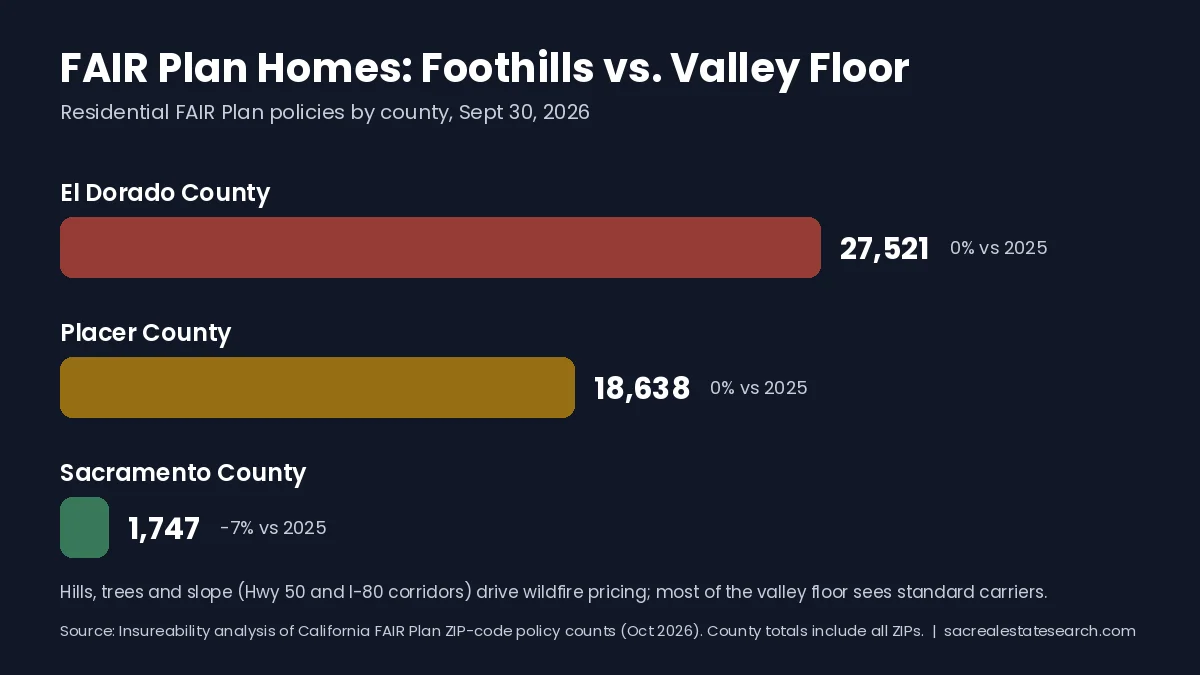
- Location drives the price. Homes up the Highway 50 and I-80 corridors (parts of El Dorado Hills, Cameron Park, Placerville, Auburn, Grass Valley) cost more to insure than most valley-floor homes. In September 2026, El Dorado County had 27,521 homes on the FAIR Plan, compared with 1,747 in Sacramento County.
- The FAIR Plan is still the fallback, and it just got pricier. It had 698,307 policies in force on Sept. 30, 2026, and its dwelling rates went up an average 29.1% for new and renewal policies starting Oct. 15, 2026.
- The market is starting to reopen. Under the state's Sustainable Insurance Strategy, 12 insurance groups have filed or been approved to grow in California. State Farm and Allstate have both filed to start writing new homeowners policies again (still under review as of Sept. 2026).
- Your contract protects you only if you use it. The C.A.R. purchase agreement has its own insurance contingency, 17 days by default. The loan contingency won't save you if you can't get insurance.
- Hardening your home lowers your premium. Defensible space, a Class A roof, ember-resistant vents and IBHS Wildfire Prepared Home certification can all earn discounts.
- Landlords and ADU owners need different coverage. Rentals need a landlord policy, tenants should carry renters insurance, and your carrier needs to know about an ADU.
Why is home insurance so expensive in Sacramento right now?
Short answer: wildfire losses, rebuilding costs, and years of insurers pulling back from California all hit at once.
When Alex and I recorded this in May 2023, she described homeowners who had been with the same company for 20 or 30 years suddenly getting non-renewal letters. Buyers chasing a "little slice of heaven" in the pines were getting quotes of $10,000 to $30,000 a year on the hardest-to-insure properties. Her words: insurance companies "stay in business because they're profitable, not because they're charities," and when the risk goes up they either raise rates or stop writing.
Here's where things stand as of November 2026:
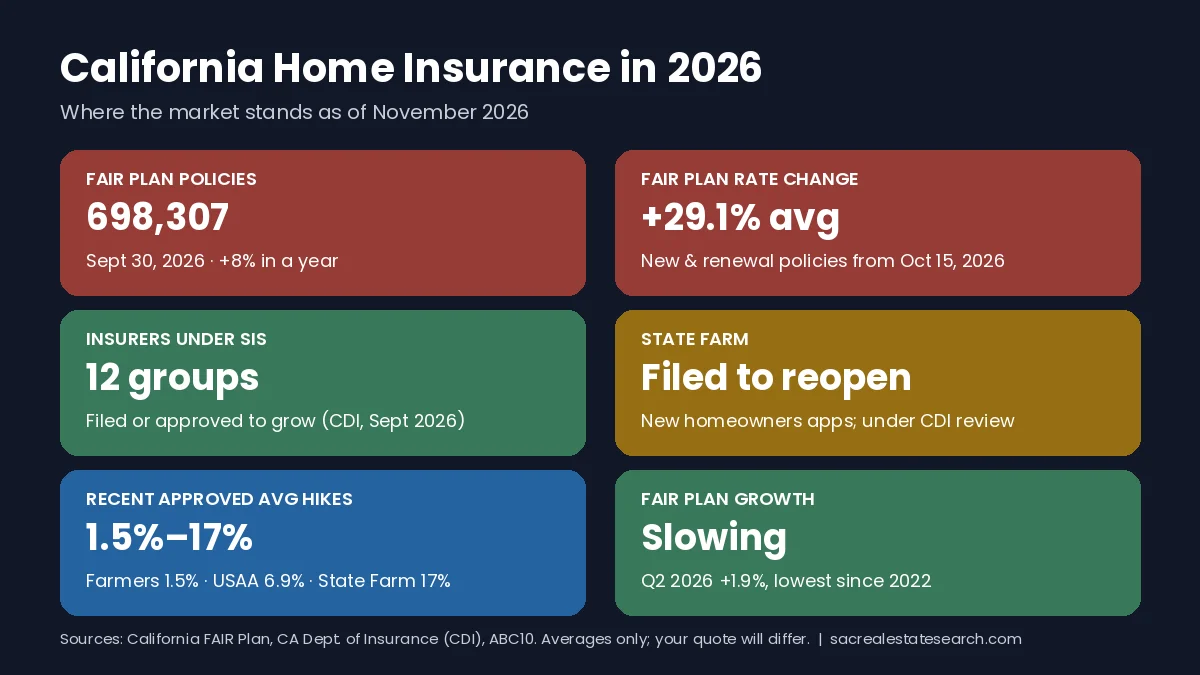
- The FAIR Plan kept growing, but more slowly. The California FAIR Plan reported 698,307 total policies in force at its Sept. 30, 2026 fiscal year-end. That's up 8% in a year and 157% since 2022. The Department of Insurance says growth has slowed for three straight quarters, and about 24,000 policies left the FAIR Plan in April and May 2026.
- FAIR Plan rates went up. The Department of Insurance approved an average 29.1% increase on FAIR Plan dwelling policies (the FAIR Plan had asked for about 36%) for new and renewing policies starting Oct. 15, 2026. Some homes will see more and some less, depending on wildfire risk.
- Regular carriers raised rates too, in smaller steps. Recent approved averages include CSAA (AAA) at about 7%, USAA at 6.9%, Mercury at 6.9%, Farmers at 1.5%, and State Farm General at 17%, which became final in July 2026.
- Insurers are coming back, with conditions. Under Commissioner Lara's Sustainable Insurance Strategy, insurers can use forward-looking wildfire catastrophe models in their rates only if they commit to writing more policies in wildfire-distressed areas (for large carriers, at least 85% of their statewide market share). As of Sept. 18, 2026, 12 insurance groups had filed or been approved, including Farmers, Mercury, CSAA, USAA, Liberty Mutual and Travelers. State Farm filed to resume new homeowners applications (for homes that meet IBHS Wildfire Prepared Home standards), and Allstate filed under SIS. Neither was open to new business yet when they filed.
Alex predicted in 2023 that insurance would probably get more expensive before it got cheaper, and so far she's been right. The good news for 2026 buyers is that more companies are writing policies again. If an agent told you "no" last year, ask again.
Where are the fire zones around Sacramento?
Short answer: If the road climbs and there are trees, expect wildfire to affect your premium.
In the video, Alex and I worked our way up the two main corridors:
- Highway 50: Things change once you get past El Dorado Hills into parts of Cameron Park, then Placerville, Camino and Pollock Pines. Alex lives in El Dorado Hills and said her own premium had "gone through the roof." Even parts of El Dorado Hills and Folsom are closer to the fire edge than people expect.
- I-80 / Highway 49: Auburn, Grass Valley and the hills toward Volcano and Amador County are classic higher-premium areas.
- The valley floor (most of Sacramento, Elk Grove, Natomas, Roseville and Rocklin's flatter areas) usually has standard carriers available, but flood is the issue to check there. We specifically mentioned Natomas, the Meadowview area and West Sacramento.
The FAIR Plan numbers show the same thing. In an Insureability analysis of the FAIR Plan's own ZIP-code counts, as of Sept. 30, 2026 there were 27,521 residential FAIR Plan policies in El Dorado County, 18,638 in Placer County and only 1,747 in Sacramento County. Sacramento County's count was down 7% from a year earlier. Statewide, the nonprofit Insurance for Good estimates that about 41% of homes in the highest-risk ZIP codes have a FAIR Plan policy, compared with about 4% everywhere else.
How to check a specific address:
- Fire: CAL FIRE Fire Hazard Severity Zone maps now include updated local (LRA) zones. The Sacramento County map came out March 10, 2025, and Placer and El Dorado counties have their own adoption pages. Sellers have to disclose the zone, and homes in Very High zones face stricter defensible-space and building rules. Reach out to me and I'll help you read the zone for any address you're considering.
- Flood: Flood risk depends on the parcel's FEMA flood zone and whether your lender will require flood coverage. Reach out to me and I'll connect you with the right resources to check a specific address.
- Insurer view: Each carrier uses its own wildfire score, so the same block can get very different answers. In 2023 Alex said carriers were "getting more granular." They look at how many policies they already have on one street, not just the zone map. Reach out to me and I'll help you get real quotes before you write an offer.
As I mentioned in the video, I've called Alex about a listing and heard, "You're fine here, but go a hundred yards up the hill and be careful." The line really can be that close.
How much does home insurance cost in a Sacramento-area fire zone?
Short answer: It depends on location, the size of the home and what it would cost to rebuild. Get a real quote for the actual address.
What Alex shared in 2023:
- In fire-zone areas like Auburn or Placerville, a 2,000 sq ft home ran roughly $2,000 to $5,000 a year as a ballpark at the time.
- Square footage matters a lot. A 4,000 sq ft home costs about twice as much to rebuild, and the premium reflects that.
- Remote, wooded or "non-standard" homes (older homes, homes on piers or posts, unusual roofs) were the ones getting the $10K to $30K quotes.
2026 update: I couldn't find a reliable published average for foothill premiums, and I'm not going to make one up. What we do know is that most carriers have taken average increases since 2023 (see above), and FAIR Plan rates just went up another 29.1% on average. For most foothill homes, plan on paying more than Alex's 2023 ballpark until we get a real quote on the actual property. Reach out to me and I'll connect you with the right resources. I've also seen it go the other way. We budgeted $4,000 a year for one client and the quote came back around $2,000.
Why this matters for your loan: Lenders count your insurance premium in your monthly housing payment. A bigger premium can lower the price you qualify for, and if you're financing in a fire zone, your lender will require proof of fire coverage before closing.
Want to see what's for sale on both sides of the line? Browse El Dorado Hills homes, Cameron Park homes, Placerville homes and Auburn homes, or compare valley-floor options in Sacramento, Roseville and Elk Grove. Thinking about El Dorado Hills specifically? My El Dorado Hills cost-of-living breakdown includes insurance in the monthly math.
When should home buyers shop for insurance?
Short answer: Before you write the offer, and no later than the day it's accepted.
Alex's biggest tip was "shop early." The order usually goes like this: you find the house, talk to your lender, make the offer, and only then call about insurance. That's backwards for anything in the hills. By the time you're close to closing, Alex said, "you're going to have less tolerance for conversations." That's how buyers end up stuck with a bad policy or a blown escrow.
What that looks like with our team:
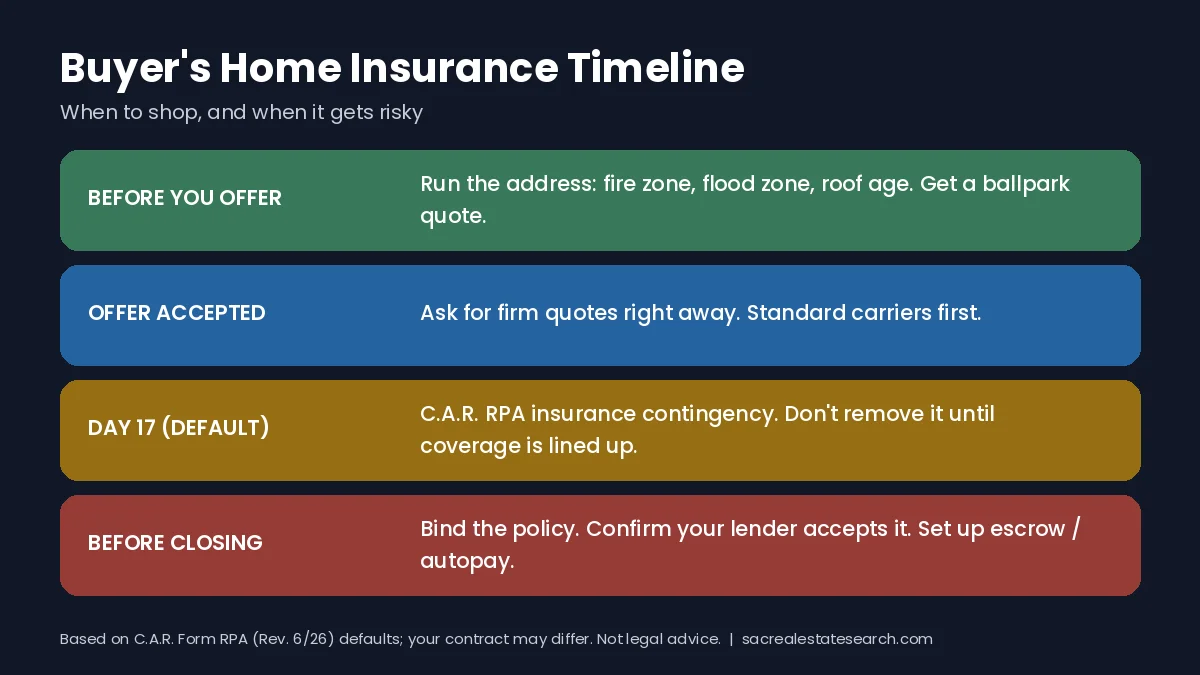
1. Before you offer: We flag fire zone, flood zone, roof age and any obvious "non-standard" features. Reach out to me and I'll connect you with the right resources for a ballpark quote across several carriers.
2. Offer accepted: Ask for firm quotes on the address right away, starting with standard (admitted) carriers.
3. Inside your insurance contingency: Don't remove it until coverage is lined up and your lender has accepted the policy in writing.
4. Before closing: Bind the policy and set up escrow or autopay so it never lapses.
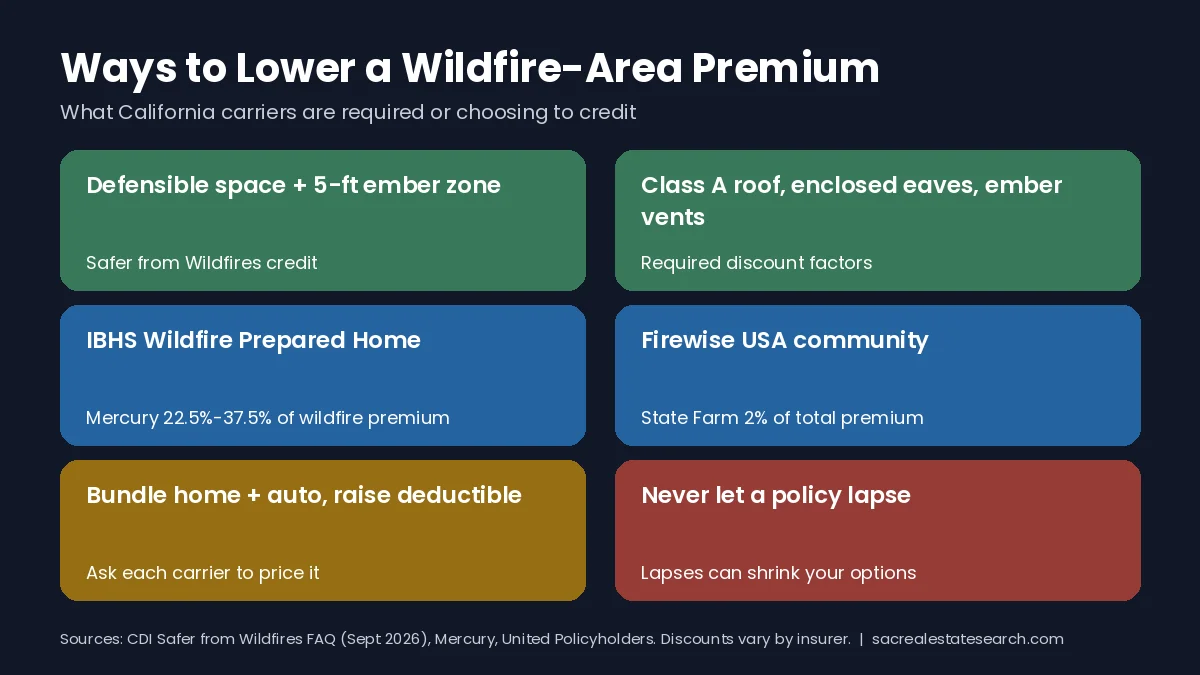
Don't let a policy lapse. Alex said this on camera: if you forget to pay and your policy lapses, the next insurer is going to ask, "You didn't pay your bill, why would we take you?" Open your insurance mail and set up autopay or an escrow account.
Does the California purchase agreement protect you if you can't get insurance?
Yes, if you keep the insurance contingency in place. This is the biggest legal change since we recorded the video, so it's worth knowing.
According to summaries of the C.A.R. Residential Purchase Agreement (Form RPA, revised 6/26):
- Insurance has its own contingency (paragraph 8D). It's based on your judgment of whether the coverage you want is available and whether you approve the cost.
- The default is 17 days after acceptance, and you can negotiate a different number.
- The loan contingency does not cover insurance. The form says that not being able to get insurance may justify canceling under the insurance contingency, but not under the loan contingency.
- It doesn't expire on its own. You remove it in writing, or the seller can cancel after giving you a Notice to Buyer to Perform.
- Waiving it to win a bidding war is risky. If you need a stronger offer, a better approach is to get a quote first and then shorten the contingency period.
Your contract may be different (counter offers, addenda, new-construction forms), so read yours carefully. Our partners walk through this with every buyer on day one. Reach out to me and I'll connect you with the right legal resources for your specific situation.
Still mapping out the region and comparing counties? Grab the free Greater Sacramento Relocation Guide. It covers Sacramento, Placer and El Dorado counties.
What is the California FAIR Plan, and is it enough?
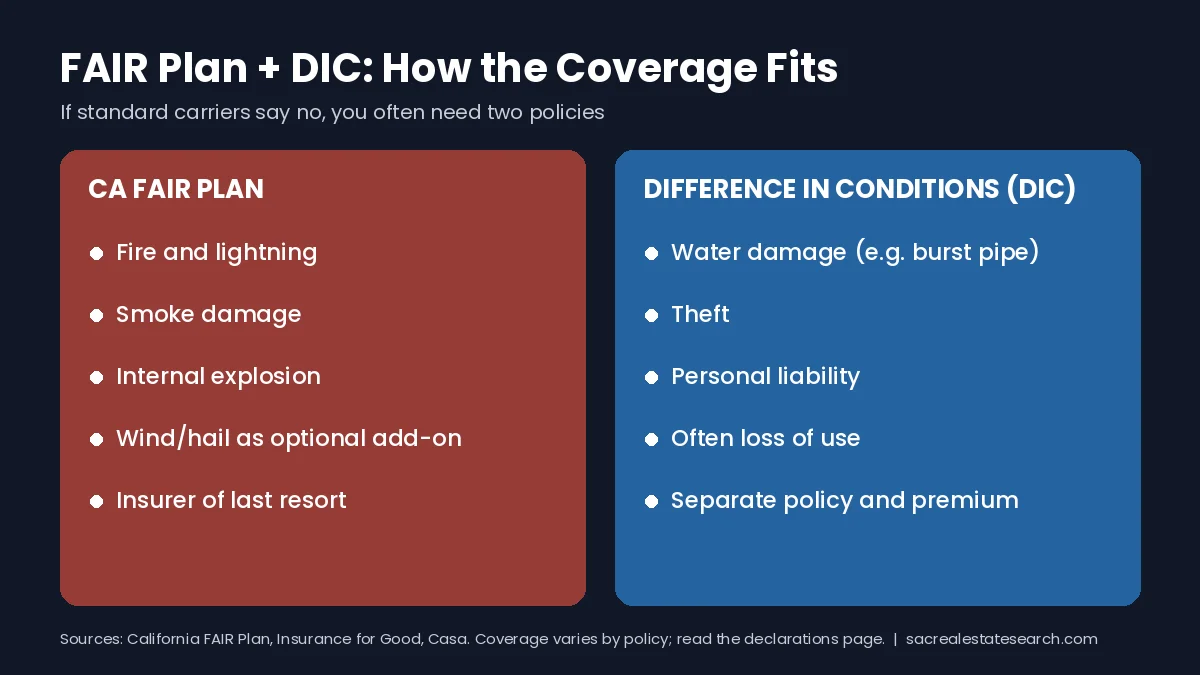
Short answer: It's the state's last-resort fire policy. On its own it usually isn't enough.
- What it covers: The FAIR Plan dwelling policy covers fire, lightning, internal explosion and smoke. Wind and hail can be added.
- What it doesn't cover: water damage from a burst pipe, theft, or someone getting hurt on your property. Most owners pair it with a Difference in Conditions (DIC) policy from a separate carrier. That's two policies and two premiums.
- Ask your lender in writing whether it will accept a FAIR Plan + DIC combination before you remove your contingency. Reach out to me and I'll help you sort that with your lender and the right insurance resources.
- Keep checking availability. The Department of Insurance has told FAIR Plan customers that more carriers are writing in wildfire-distressed areas under the new rules. Reach out to me when you renew and I'll connect you with the right resources to check again.
How can you lower your home insurance premium?
You can't move the hill, but you can change how risky your home looks to an insurer:
- Harden the home. California's Safer from Wildfires regulation requires insurers that price for wildfire risk to give a separate discount for each required mitigation step. These include a cleared 5-foot ember-resistant zone, defensible space, a Class A roof, enclosed eaves and ember-resistant vents. The Department of Insurance's September 2026 FAQ says each required step must be worth at least $1, and the amount varies a lot by carrier.
- Get certified. An IBHS Wildfire Prepared Home designation can earn a bigger discount with some carriers. For example, Mercury lists a 22.5% to 37.5% discount on the wildfire portion of the premium. State Farm's planned reopening is built around these certifications. Not every insurer credits it. Reach out to me and I'll connect you with the right resources to compare.
- Community programs count too. According to United Policyholders, State Farm gives a 2% discount for living in a Firewise USA community, and the FAIR Plan has a list of wildfire discounts of its own.
- Bundle and adjust the deductible. Bundling home and auto and choosing a somewhat higher deductible are standard ways to save. Alex raised her own deductible so she'd only file a claim when it really mattered.
- Compare carriers through the right resources. Alex moved from a single-company agency to a brokerage so she could shop several carriers for clients. In this market, being able to compare companies is a big advantage. Reach out to me and I'll connect you with the right resources.
- Don't treat insurance like a home warranty. Claims stay on your record. Small claims, like a dishwasher leak that isn't even covered, can follow you and make you harder to insure next year. Reach out to me first and I'll connect you with the right resources before you decide whether to file.
What insurance do landlords and ADU owners need?
The second half of the video is for investors and for owners who are keeping their low-rate home as a rental when they move:
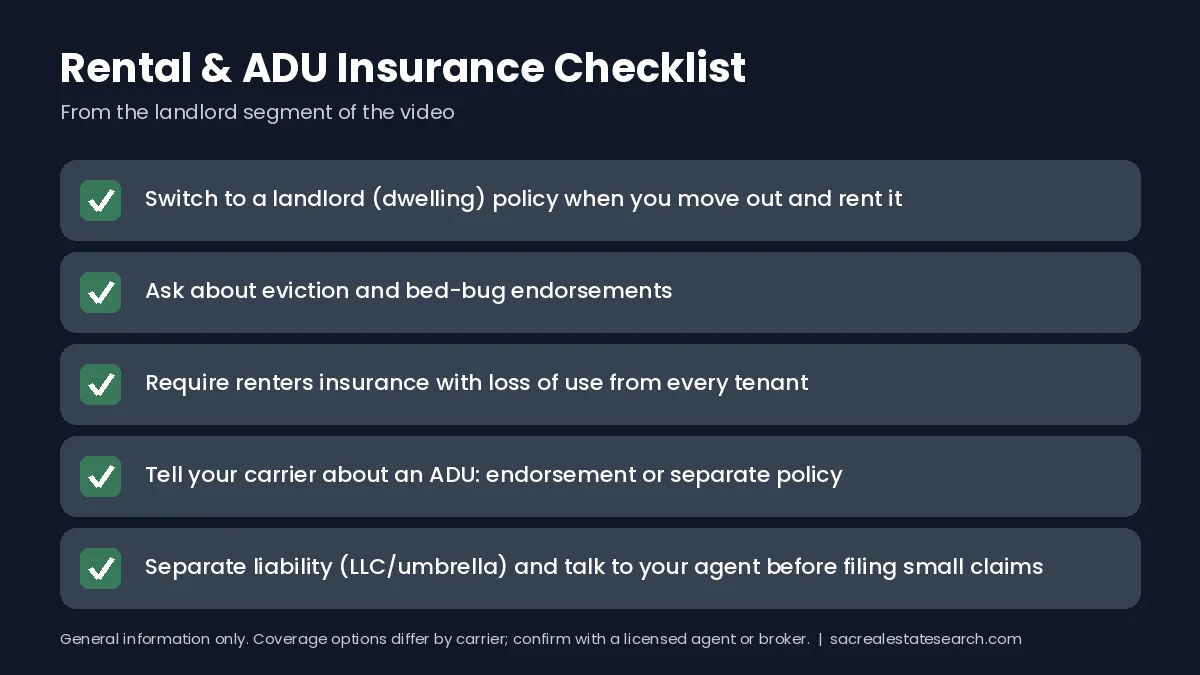
- Switch to a landlord policy. If you keep your 3% house and rent it out, your homeowners policy doesn't automatically become a rental policy. Alex warned that if you're not living there but your policy says you are, the insurer can deny a claim.
- Look for landlord-only coverages. Alex had a carrier whose landlord policy included eviction protection and bed-bug coverage, which a regular homeowner policy can't get. In California, eviction coverage is a big deal.
- Require renters insurance. Renters insurance with loss of use pays for your tenant's temporary housing after a covered loss. Alex worked claims after the Camp Fire in Paradise, where some renters without loss-of-use coverage ended up sleeping in a Walmart parking lot. It's inexpensive and it protects you as the landlord too.
- Separate your liability. If your rentals and your personal home are tied together, a claim on one can affect your coverage and your assets. Reach out to me and I'll connect you with the right insurance and legal resources about an LLC or umbrella policy.
- Condos and HOAs: Alex had a pipe burst in her condo that leaked into the unit below. Sorting it out meant dealing with the HOA's master policy, the property manager and her own coverage. Know your HOA's master policy and your own walls-in coverage.
- ADUs: If the ADU has its own kitchen and bathroom and someone lives there, it isn't like adding a shed. Depending on the carrier, it may need an endorsement or a separate policy. Reach out to me before you rent it out and I'll connect you with the right resources.
FAQ: Sacramento home insurance for buyers
Can I still get homeowners insurance in the Sacramento foothills?
Yes, but you'll have fewer choices and pay more than on the valley floor. Reach out to me and I'll connect you with the right resources to check admitted carriers, specialty (surplus lines) options, and the FAIR Plan plus a DIC policy as the last resort.
Is the FAIR Plan bad?
It's limited, not bad. It covers fire and smoke, but you'll usually need a DIC policy for water damage, theft and liability. FAIR Plan rates also rose an average 29.1% starting Oct. 15, 2026.
Do I need flood insurance in Natomas or West Sacramento?
It depends on the parcel's FEMA flood zone and your lender. Reach out to me and I'll connect you with the right resources to check the flood zone and get a quote early. Alex noted there are private flood options besides the federal program.
What if my insurance quote comes in too high during escrow?
If your insurance contingency is still open, you can cancel in writing, in good faith, under the standard C.A.R. form. Call your real estate partner right away, before the deadline. Once you remove the contingency, the problem is yours to solve.
Are insurers coming back to California?
Some are. As of September 2026, 12 insurance groups had filed or been approved under the Sustainable Insurance Strategy, and State Farm and Allstate had filed to reopen to new homeowners business. Approvals and actual availability vary, so reach out to me every year and I'll connect you with the right resources to check again.
Thinking about buying in the Sacramento foothills?
If you're looking at El Dorado Hills, Cameron Park, Placerville, Auburn or anywhere up the hill, I'll help you spot insurance issues before you fall in love with a house. Reach out to me and I'll connect you with the right resources to quote the address early.
- 📅 Book a 1-on-1 strategy call (the best next step if you're serious about buying in the next 6–12 months)
- 📞 Call or text Jake: (916) 402-5786
- 🏡 Search Greater Sacramento homes for sale
- 📘 Still mapping the region? Grab the free Greater Sacramento Relocation Guide (Sacramento, Placer and El Dorado counties).
Related reading:
- Moving to El Dorado Hills: what it really costs
- Moving to Fair Oaks, CA: pros, cons & what to know
- Moving to Carmichael, CA: pros, cons & what to know
- Sacramento housing market update 2026
- 6 things to know before moving to Sacramento
Jake DaRosa | The DaRosa Team | Keller Williams Roseville, powered by PLACE
📧 jake@sacrealestatesearch.com · 📞 (916) 402-5786 · 🌐 sacrealestatesearch.com
DRE #01704082 | Brokerage DRE #01406150
This article is general information, not insurance, legal or tax advice. Jake DaRosa is a real estate broker, not a licensed insurance agent. Insurance availability, rates, discounts and contract forms change often. Reach out to me and I'll connect you with the right insurance and legal resources to confirm coverage and contract questions. Information is deemed reliable but not guaranteed. Equal Housing Opportunity.
or another way