

Categories
Buying a HomePublished November 11, 2026
Sacramento Home Inspections: Why Waiving Them Can Backfire

When the market gets competitive, the first thing buyers want to cut is the inspection. I get it. You've lost a few houses, you finally find the one, and waiving everything feels like the only way to win. But the inspection is where you find out what you're actually buying. I sat down with longtime Sacramento-area inspector Steffan Gilbert for a video interview to break down the pest (termite) report, the home inspection, roof and sewer lateral inspections, and what buyers should really be reading. Below is the full conversation plus what I checked for this post in November 2026.
Video conversation by Jake DaRosa, The DaRosa Team | Keller Williams Roseville, powered by PLACE, with inspector Steffan Gilbert (published June 2023). Watch on YouTube.
Prefer watching? Subscribe on YouTube for weekly Greater Sacramento market updates, neighborhood tours and conversations with the pros we trust.
Heads up: This post is general education from a real estate broker, not legal or construction advice. Contract forms and costs change. Reach out to me and I'll connect you with the right resources for your situation.
Key Takeaways
- Skipping the inspection is a gamble. In a 2021 Angi survey of 1,000 people who moved during the pandemic, about 1 in 4 skipped a formal inspection, and 20% of those called it a terrible mistake.
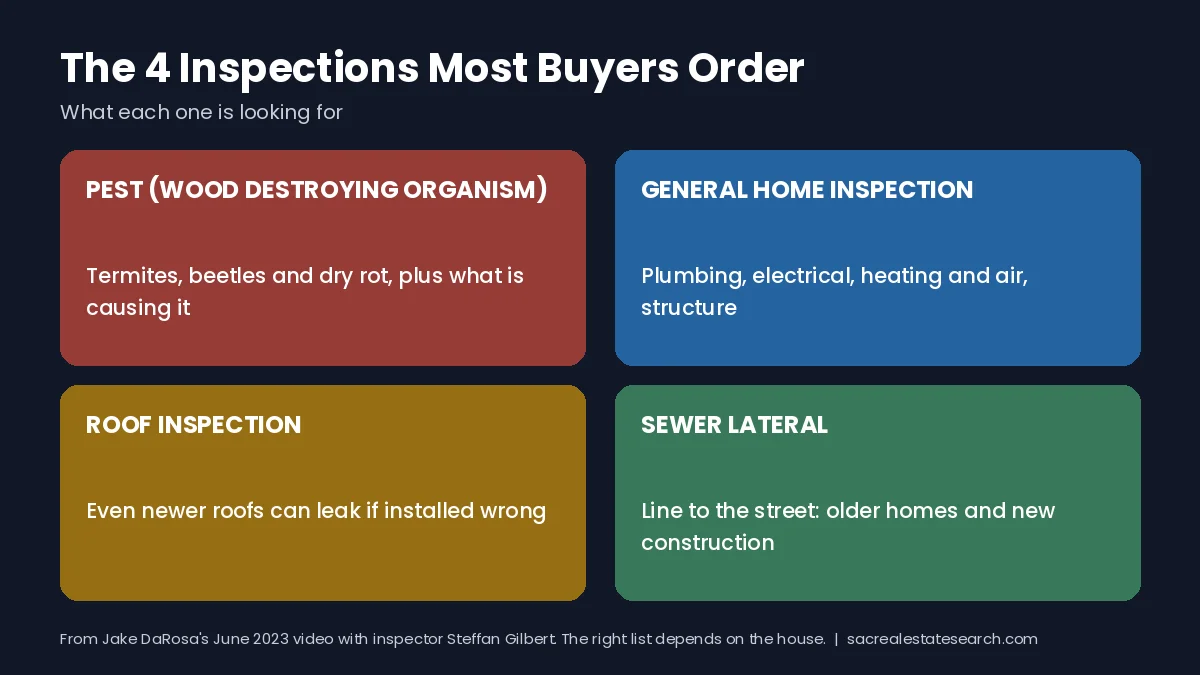
- Most buyers order four inspections: the pest (wood destroying organism) inspection, the general home inspection, a roof inspection and, depending on the home's age, a sewer lateral inspection.
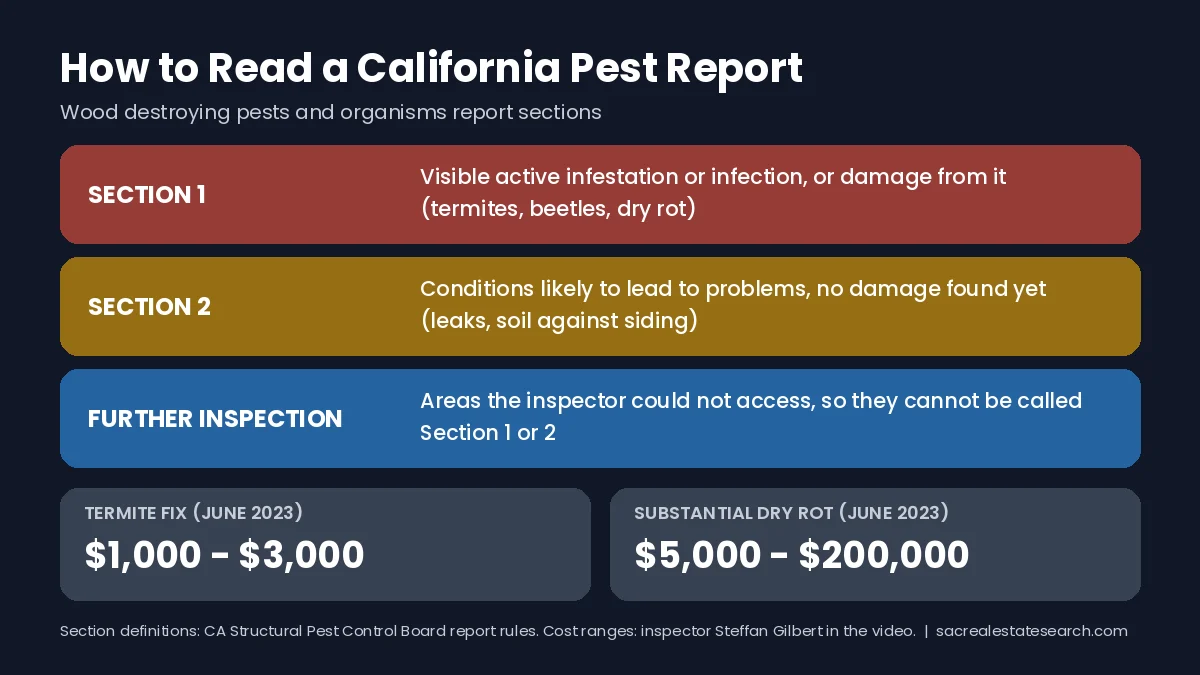
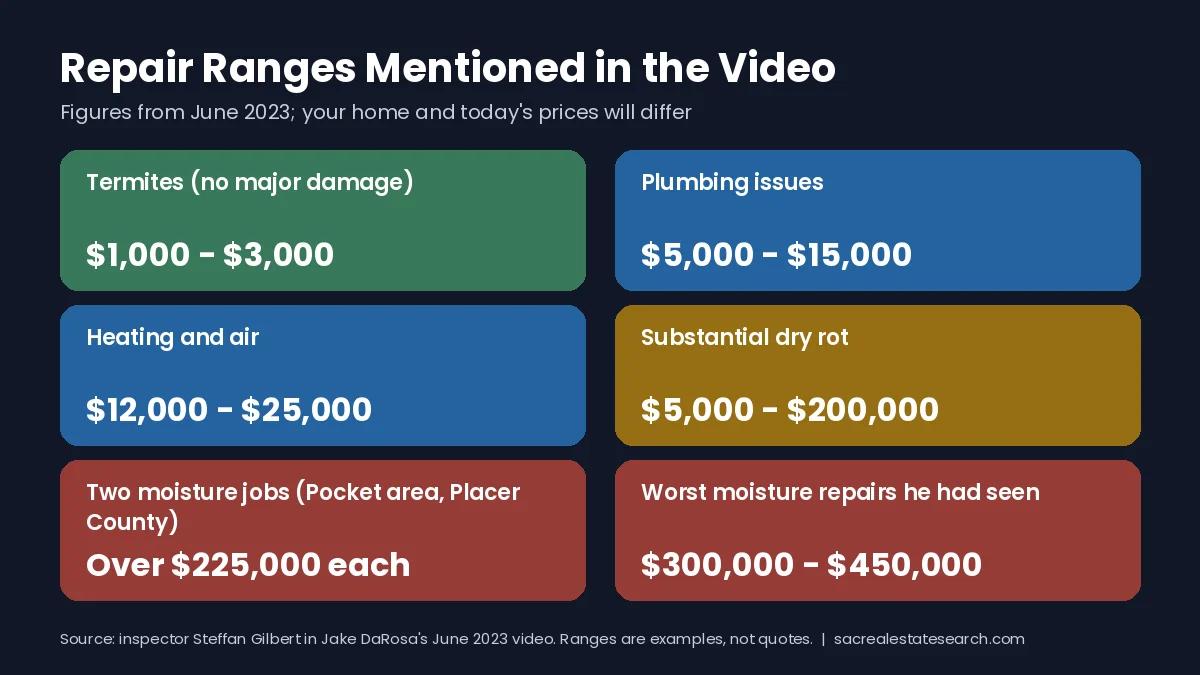
- Dry rot is the big-ticket item. In June 2023, Steffan put termite fixes at about $1,000 to $3,000, while a substantial dry rot problem could run $5,000 to $200,000 depending on where the damage is.
- "Further inspection" items are where deals go wrong. If the inspector couldn't get into the crawlspace or attic, find out why before you remove your contingency.
- Home inspections are not all the same. California doesn't license home inspectors, so read the inspection agreement and the first pages of the report to see what was actually checked.
- You don't have to waive to compete. California's standard purchase agreement gives you 17 days by default to investigate. You can shorten that period instead of giving it up.
Do buyers really regret waiving the home inspection?
Short answer: Many do. The ones who skip it usually find out the hard way.
I opened the video with a stat that 43% of 2021 buyers who waived their inspection contingencies were unhappy with their home. When I went back to find that survey for this post, I couldn't confirm the original source, so I'm not going to lean on that number here. Here's what I could verify.
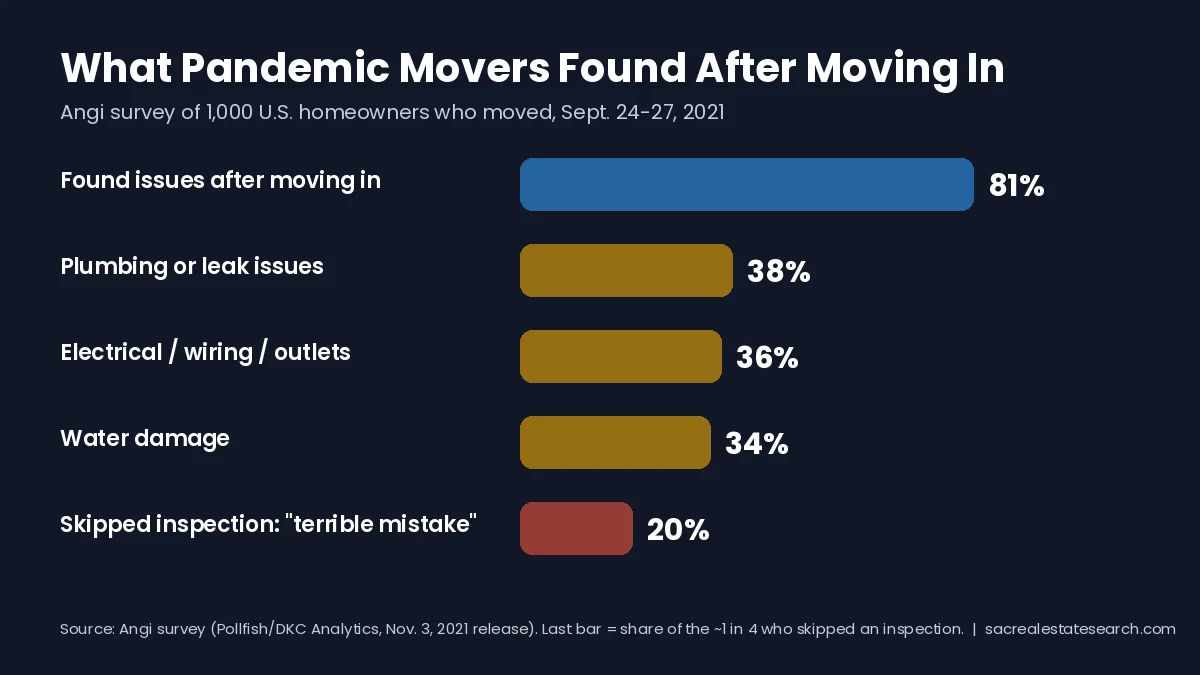
In Angi's survey of 1,000 U.S. homeowners who moved during the pandemic (conducted Sept. 24–27, 2021):
- Nearly 1 in 4 skipped a formal inspection before moving in. They said they wanted to move faster, were confident they could fix things themselves, or didn't want to be outbid.
- 20% of the people who skipped it called it a terrible mistake.
- 81% of everyone surveyed found issues after moving in, and over 40% found major issues. The most common were cosmetic (40%), plumbing and leaks (38%), electrical (36%) and water damage (34%).
- Movers averaged about $3,000 in surprise costs.
Steffan sees the same pattern. Buyers lose four houses in a row, start waiving everything, and two weeks after they move in they find a plumbing problem, an air conditioner that doesn't work and a side gate that won't latch. Then they remember they paid $20,000 over asking. As he put it, the inspection "gets us all on the same page and they know what they're paying for."
For the record, I have not had clients waive inspections. I've shortened them, but we always made sure an inspector got out there.
What inspections should you get when buying a home in Sacramento?
Short answer: Pest, home and roof on almost every house, plus a sewer lateral inspection on older homes (and, according to Steffan, on new ones too).
- Pest inspection (wood destroying organism report): Despite the name, it isn't about rats. It's about termites, beetles and especially dry rot.
- General home inspection: Plumbing, electrical, heating and air, and the structure and major components of the house.
- Roof inspection: Steffan thinks everyone should get one. "We have brand new roofs that leak," he said, and even a 25-year roof can leak if it wasn't installed correctly. I've also seen sellers call it a "new roof" when all they did was lay new shingles over the old ones.
- Sewer lateral: This is the line from the house to the street. On homes from the 1950s, '60s and '70s, different pipe materials and roots from mature trees can cause problems. Steffan added a surprise: his team saw more blockages on brand new construction than on older homes, because job-site debris like grout, sawdust and caulking gets swept into open plumbing lines before the toilets go in.
When I see original heating and air that's 20 or 30 years old, I want it looked at too. The goal is to get the right inspections for the house, not just the minimum.
What does a California pest (termite) inspection look for?
Short answer: Damage you can see now, conditions that could cause damage later, and areas nobody could get to.
In California these reports are handled by companies registered with the state's Structural Pest Control Board. The inspector's job isn't just to say something is rotted. Steffan said that's "only 50 percent of the ball game." The other half is finding what's causing it, so the repair doesn't fail again in two or three years. He's seen people replace rotted siding without noticing a sprinkler spraying the wall, and a year and a half later eight sheets of siding were rotted all over again.
The report is split into sections. Under Structural Pest Control Board rules:
- Section 1: Visible evidence of active infestation or infection (like termites or beetles), or damage that resulted from it. This is where dry rot and water intrusion show up. Steffan noted that a decade before our 2023 conversation, many lenders wanted Section 1 items addressed.
- Section 2: Conditions likely to lead to infestation or infection, but with no visible evidence yet. Think a plumbing leak or dirt touching the side of the house.
- Further inspection: Areas the inspector couldn't access, so they can't be classified as Section 1 or 2. Steffan called these the real deal breakers. "They're what cause the mediations, they're what cause the lawsuits."
What it costs (June 2023 figures from the video): Everyone panics about termites, but Steffan said even bad termite problems ran about $1,000 to $3,000 to fix unless they'd already done damage. A substantial dry rot problem could be $5,000 to $200,000, depending on where it is. Trim, fascia and eaves are fairly easy to fix. The wood framing inside the walls that holds the house up is what gets expensive.
Why do "further inspection" items matter so much?
Short answer: Because the inspector only sees a small part of the house, and the hidden part is where the expensive surprises are.
Steffan said inspectors see maybe 10 to 15 percent of the wood in a house. Everything else is a prognosis based on "the tip of the iceberg." So when the report says further inspection, ask the inspector directly: does this look isolated, or do we need to open it up and look inside the wall?
His example: a crawlspace hatch inside a closet that someone covered with new laminate flooring. Nobody has been under the house in years, maybe decades. If the deal closes and the new owner later sends an electrician or plumber under there and finds major damage, they're going to be upset. And the inspection company will point to the page of the report that recommended further inspection. In a busy escrow, people don't always read that page.
I learned this on one of my own deals. There was dry rot on the fascia above a garage, a couple thousand dollars' worth, and the seller wanted to give us a credit. I asked for it to be opened up for further inspection instead. We found about another $8,000 of damage, and the main beam had to be replaced. Taking the credit would have left my client with that bill.
I'm fine taking a credit for small things, like rafter tails that just need to be cut back. When there's a rotted section and nobody knows what's behind it, open it up before you remove your contingency.
Keep in mind that the standard C.A.R. purchase agreement doesn't let buyers do invasive or destructive testing without the seller's written consent (that's how the version I reviewed reads, so check the one you sign). That's why it matters to ask early and get the seller on board.
What are the biggest repair costs inspectors find?
Short answer: Dry rot from water getting into the structure, by a wide margin.
Steffan's view is that a house "is only as good as the waterproofing put on the house," whether it's a $500,000 home or a $12 million one. In inland Northern California, he said, building plans put a lot of work into engineering but often fall short on waterproofing details, because we're used to dry weather. When wind-driven rain finally hits, houses leak.
He said it's not uncommon in some of the very affluent neighborhoods around town. Water gets in under decks and balconies and behind stone or brick veneer. Faux-painted, textured interior walls can hide the staining. The moisture gets in during the rainy months, then the heat of summer makes it sweat. In 2023 he described repairs of $300,000 to $450,000, and two active jobs, one in the Pocket area and one in Placer County, that were each over $225,000 because of a poor flashing detail where a roof deck tied into walls and concrete-topped balconies. It had compromised load-bearing beams holding up three-story homes.
The other big systems he walked through (June 2023 figures):
- Plumbing: Leaks happen inside walls and under the ground where you can't see them. He put typical plumbing issues at about $5,000 to $15,000, and insurance can sometimes help with a flood.
- Heating and air: Depending on the work, he put heating and air at about $12,000 to $25,000.
- Electrical: Owners modify homes without permits, tap in and overload circuits. Plumbing and HVAC problems make you uncomfortable. Electrical problems can cause a fire, so this is a health and safety issue as well as a cost.
- Roof: Even newer roofs can leak if they weren't installed right, and a leak can do a lot of damage.
Want to see what's on the market right now? Browse Sacramento homes, Roseville homes, Elk Grove homes and Folsom homes, or search all of Greater Sacramento.
How do you know if a home inspection was thorough?
Short answer: Read the inspection agreement and the first two pages of the report.
Here's something a lot of buyers don't know: California does not license home inspectors. The state regulates them through a practice act in the Business and Professions Code, which defines a home inspection as a noninvasive physical examination of the plumbing, electrical, mechanical and structural parts of a one-to-four-unit home, looking for material defects. Many inspectors belong to associations like ASHI and CREIA that set their own standards. Pest inspections are different. Steffan pointed out they follow a state-mandated protocol.
That's why Steffan's advice was so simple: read the first two pages of the report and read the inspection contract, because not every inspection covers the same things. He explained that some inspectors check a representative sample. If there are 100 outlets, they might test 50. If you plug a lamp into one of the 50 that wasn't checked and it doesn't work, you won't be happy hearing it was a sample. A short report can mean a great house, or it can mean the inspector didn't check much.
Questions I'd ask:
- Are you checking every window, door, outlet and heating/air vent, or a sample?
- What areas couldn't you get into, and why?
- Does anything here need a specialist (roof, sewer, structural) before we remove contingencies?
- Do you offer any guarantee after the inspection? In 2023, Steffan said his company added its own coverage for up to 120 days after certain inspections, for things like a water heater that fails during move-out.
Reach out to me and I'll connect you with the right resources for each inspection on your list.
Should sellers do a pre-listing inspection?
Short answer: It often helps.
Steffan is a fan of pre-list inspections, meaning pest, roof and home inspections done before the house goes on the market. It gets everything out in the open early so it can be talked through at the front end of the deal instead of blowing up in escrow.
Two things to keep in mind as a buyer:
- A seller's report is a starting point, not a substitute. You can still order your own.
- Homes change with use. Steffan's example was a house where an older couple had lived quietly for years, and then a family of five moved in and started running water all day. Systems that seemed fine can show problems once usage changes.
How can you compete without waiving inspections?
Short answer: Shorten the timeline instead of giving up the protection.
In the video, Steffan noted that a few years earlier buyers often had 14 to 17 days to inspect, and by 2023 it was often a five-day window in competitive situations. Getting reports back, handling the loan and understanding the neighborhood in that time is a lot, even for experienced agents.
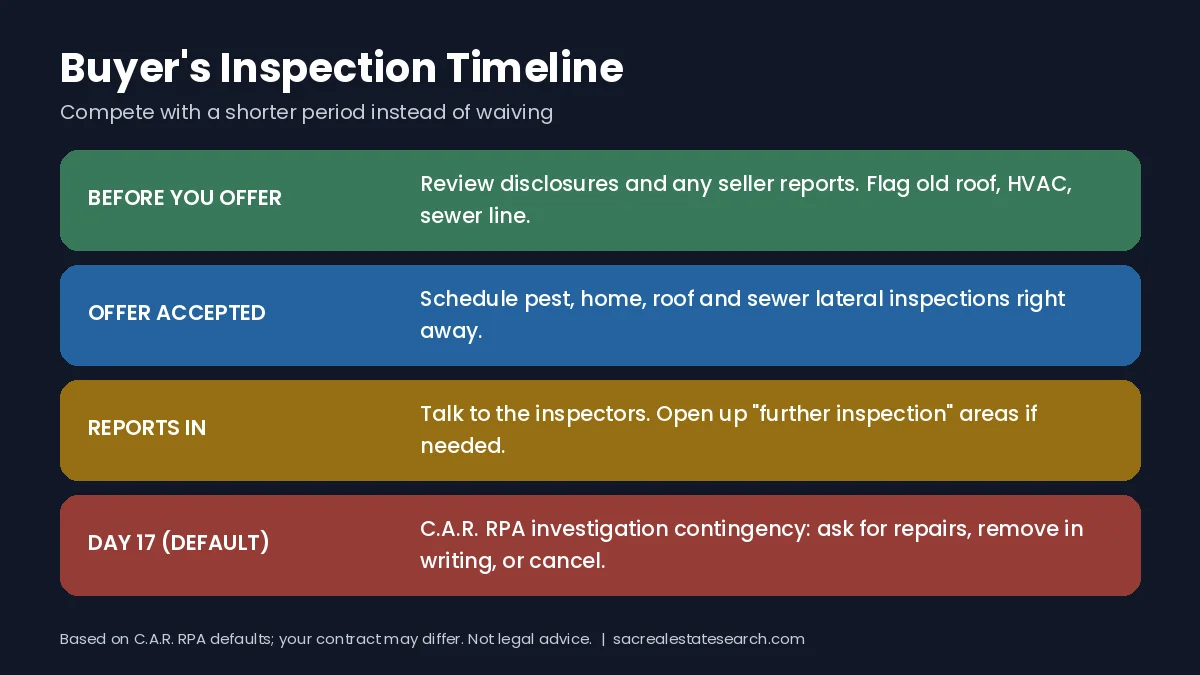
Under the current C.A.R. Residential Purchase Agreement, the buyer's investigation contingency defaults to 17 days after acceptance unless you write in a different number. You have to remove it in writing, and it doesn't just expire. If you miss it, the seller has to give you a Notice to Buyer to Perform before they can cancel.
What that looks like with our team:
1. Before you offer: We review disclosures and any seller inspection reports, and flag age-related items like an original roof, old heating and air, or an older sewer line.
2. Offer accepted: We schedule pest, home, roof and (when it makes sense) sewer lateral inspections right away.
3. Reports in: We talk with the inspectors, especially about further inspection items, and decide what needs to be opened up.
4. Before the deadline: You either ask for repairs or credits, remove the contingency, or cancel.
Why expectations matter: Steffan's point is that a good agent understands who they're helping. A first-time buyer who saved for nine years may not be able to absorb even a $1,000 repair. In 2023, rates were over 6%. As of Nov. 5, 2026, Freddie Mac's weekly survey had the 30-year fixed average at 7.18%, so surprise repair bills are just as hard to absorb today. An experienced investor or a contractor who can fix things himself may be comfortable with more risk. Waiving makes the most sense for people who know exactly what they're taking on.
Don't forget insurance. With insurers pulling back in California, a big claim soon after closing can follow you and push you toward pricier coverage. I covered that in my Sacramento home insurance guide. No house is perfect, and there's always a cost to owning one. What matters is knowing the major items have been looked at.
Still mapping out the region? Grab the free Greater Sacramento Relocation Guide. It covers Sacramento, Placer and El Dorado counties.
FAQ: Home inspections for Sacramento buyers
Should I waive the home inspection to win a bidding war?
I don't recommend it. A shorter inspection period is usually a better trade-off than no inspection. In Angi's 2021 survey, 20% of buyers who skipped an inspection called it a terrible mistake.
What's the difference between Section 1 and Section 2 on a pest report?
Section 1 is visible active infestation, infection or damage from it, like termites or dry rot. Section 2 is a condition likely to cause problems later, like a leak or soil against the siding, with no damage found yet.
What does "further inspection" mean on a termite report?
The inspector couldn't access an area (a covered crawlspace hatch, a blocked attic, a deck soffit), so they can't say whether there's damage. Get it looked at before you remove your contingency.
Are home inspectors licensed in California?
No. California doesn't license home inspectors, but state law sets a standard of care and report requirements, and many inspectors follow ASHI/CREIA standards. Pest (wood destroying organism) inspections are handled by companies registered with the Structural Pest Control Board.
Do I need a sewer lateral inspection on a newer home?
It's worth considering. Steffan said his team found more blockages on brand new construction than on older homes because construction debris gets swept into the lines.
How long do I have to do inspections in California?
The standard C.A.R. purchase agreement gives you 17 days after acceptance by default, and you can negotiate a different number. Read the version you sign.
Thinking about buying in Greater Sacramento?
If you're house hunting in Sacramento, Placer or El Dorado County, I'll help you write an offer that competes without flying blind on the house's condition. Reach out to me and I'll connect you with the right resources for every inspection on your list.
- 📅 Book a 1-on-1 strategy call (the best next step if you're serious about buying in the next 6–12 months)
- 📞 Call or text Jake: (916) 402-5786
- 🏡 Search Greater Sacramento homes for sale
- 📘 Still mapping the region? Grab the free Greater Sacramento Relocation Guide (Sacramento, Placer and El Dorado counties).
Related reading:
- Sacramento home insurance: what buyers need to know
- Sacramento housing market update 2026
- Moving to El Dorado Hills: what it really costs
- Moving to Carmichael, CA: pros, cons & what to know
- Moving to Fair Oaks, CA: pros, cons & what to know
- 6 things to know before moving to Sacramento
Jake DaRosa | The DaRosa Team | Keller Williams Roseville, powered by PLACE
📧 jake@sacrealestatesearch.com · 📞 (916) 402-5786 · 🌐 sacrealestatesearch.com
DRE #01704082 | Brokerage DRE #01406150
This article is general information, not legal, construction or inspection advice. Jake DaRosa is a real estate broker, not a licensed inspector or contractor. Repair costs in this post are ranges mentioned in a June 2023 video and will vary by home. Contract forms and timelines change. Reach out to me and I'll connect you with the right resources to confirm inspection and contract questions. Information is deemed reliable but not guaranteed. Equal Housing Opportunity.
or another way