

Categories
Sacramento Real EstatePublished November 18, 2026
What Is a Living Trust? Estate Planning Basics for Sacramento Homeowners

I put off doing my own trust for years. I finally wrote my first one at 47, and honestly, it was a lot easier than I expected. I've also seen the other side from real estate: families who have to sell or transfer a home when nobody set up a trust, and it turns into months of court. So in September 2023 I sat down with Dustin McFarlane, the estate planning attorney who had just finished my trust, to cover the basics every homeowner should know. Below is the full conversation plus a rundown of what we covered.
Video conversation by Jake DaRosa, The DaRosa Team | Keller Williams Roseville, powered by PLACE, with estate planning attorney Dustin McFarlane (published September 2023). Watch on YouTube.
Prefer watching? Subscribe on YouTube for Greater Sacramento market updates, neighborhood tours and conversations with the pros we trust.
Heads up: I'm a real estate agent, not an attorney, and this post isn't legal advice. Everything below is what was said in our September 2023 conversation. Laws and timelines change, and every family is different, so talk with a licensed California estate planning attorney about your own situation.
Key Takeaways
- Everyone already has a "will." If you don't write your own, California's intestate succession rules decide who inherits, and a judge oversees it through probate.
- Probate takes time. Dustin said it usually means hiring a lawyer and takes a year to a year and a half, and he described 18 to 24 months on the back end in some cases.
- Getting sick without a plan can be worse. Without a power of attorney, trust and health care directive, a conservatorship court can end up deciding where your money goes and who makes your health care decisions.
- Don't add kids or grandkids to your deed "just in case." Dustin shared a story where it left a homeowner unable to sell without going to court.
- A trust costs less than the alternative. Dustin said what you spend on a trust is roughly one-tenth of what court would cost your family.
- The work doesn't stop at signing. Connecting your home and bank accounts to the trust, and reviewing it as life changes, is what makes it work.
What happens if you die without a will or trust in California?
Short answer: The state already has a plan for you, and a court has to carry it out.
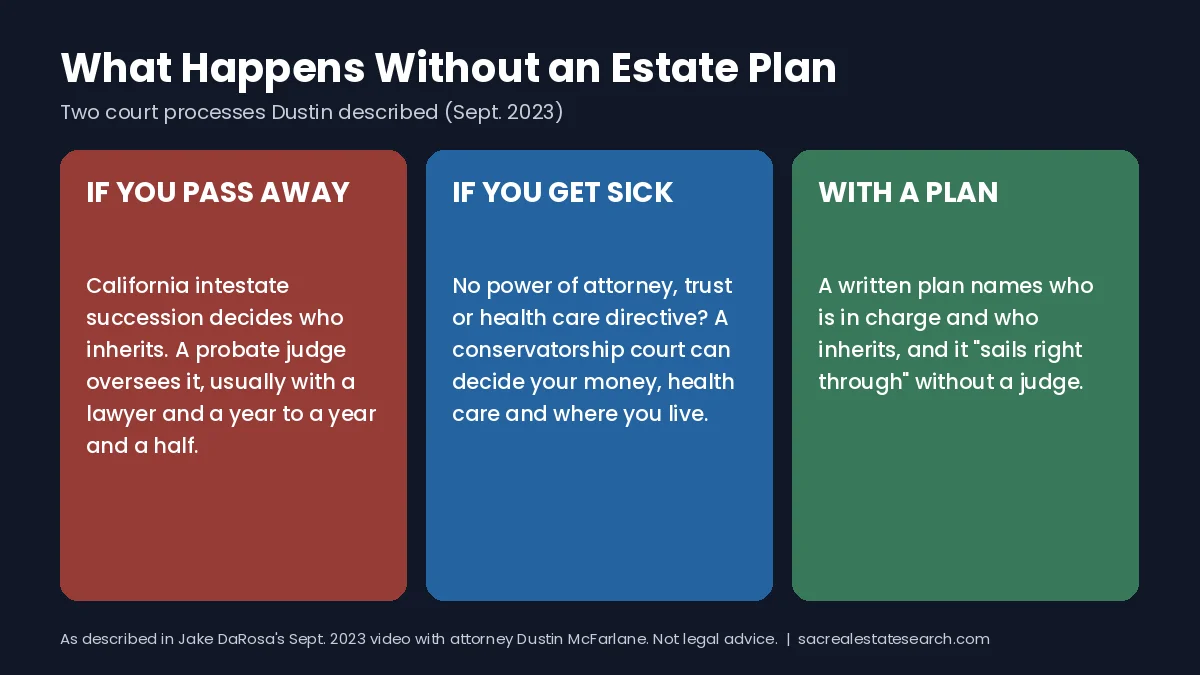
Dustin put it this way: everyone has a will, even if you've never written one. If you don't write your own, the government has one for you. It's called intestate succession, and it's the state's order of who gets your stuff when you die. In most cases, he said, it just doesn't go the way you'd want.
It also doesn't happen automatically. A judge has to oversee the distribution and make sure your house, the money in your bank and everything else goes the way the state's order says. Dustin said that usually requires hiring a lawyer and takes a year or a year and a half.
From my side, I've watched people go through this after losing someone. There's already a lot to handle when a family member passes away. Adding court on top of that is the last thing anyone wants. As Dustin said, the legal fees aren't even the worst part. The emotional toll on the family is.
What if you get sick without a power of attorney or health care directive?
Short answer: You can end up in a different kind of court: a conservatorship.
This was the part a lot of people don't think about. If you get sick and you don't have a power of attorney, a trust or a health care directive in place, Dustin said you're back in probate court, but this time it's a conservatorship. In that process the state can step in and decide where you spend your money, who makes your health care decisions and where you live.
An estate plan is the written version of your wishes. It names:
- Who's in charge of your money and property if you get sick
- Who makes your health care decisions
- Who's in charge when you die, and who inherits what's left
With that in place, Dustin said, things "sail right through" without needing a Superior Court judge to sign off.
When I did mine, I thought about things like a car wreck or being on life support. I put my wishes in writing. It actually helped me get some clarity on what I want, for myself and for my family.
What can go wrong when there's no plan? Two real stories
Short answer: The law steps in, and the results can hurt the very people you meant to protect.
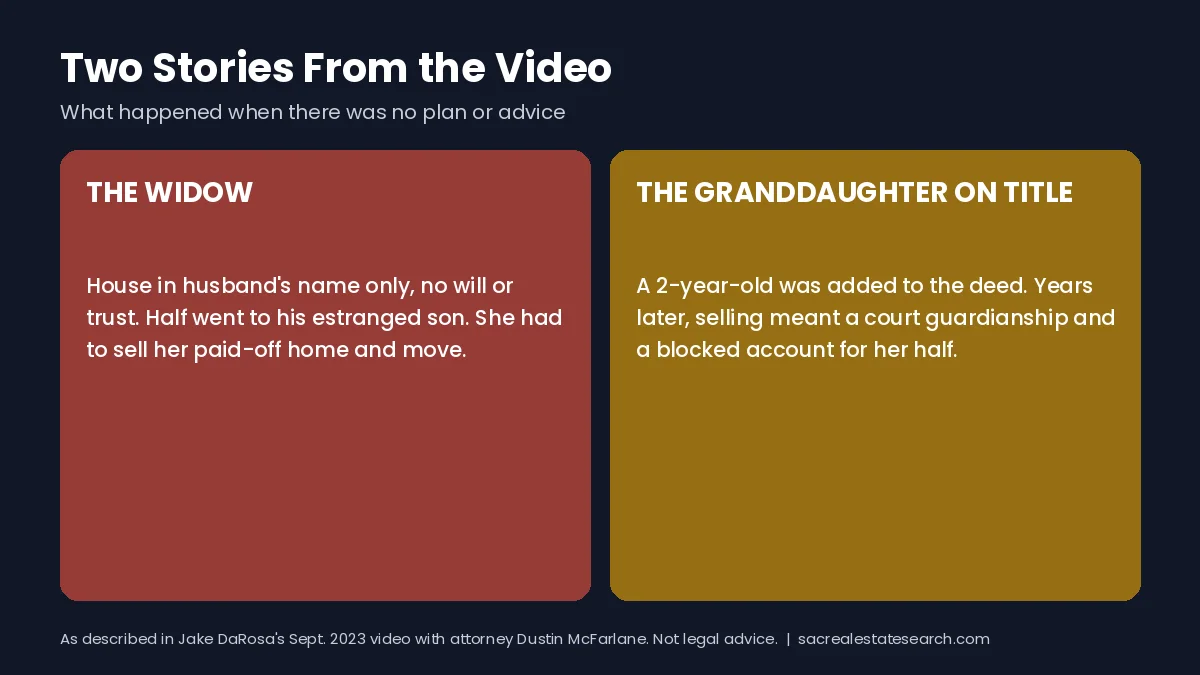
Story 1: The widow who lost her house. Dustin described a woman whose husband passed away after about 20 years of marriage. The house was in his name only, and he owned it before they married. There was no will and no trust. He had a son from a previous marriage who had been estranged for years. As Dustin explained it, under the state's rules in that situation, half went to the surviving spouse and half went to the son. She didn't have the cash to buy out the son's half, so the house had to be sold and the money split. Instead of staying in her paid-off home near her church, her friends and her neighbors, she had to move. Dustin's point: that wasn't the husband's wish, it wasn't hers, and it probably wasn't even the son's.
Story 2: The granddaughter on the deed. Another woman had been told by a coworker, years earlier, to add her granddaughter to the deed. About seven years before she came in, she added her then two-year-old granddaughter to title, with no legal advice. Later she couldn't afford the mortgage and wanted to sell and downsize. Because her granddaughter (by then 12) was on title, Dustin said she'd have to go to court for a guardianship, and the granddaughter's half of the equity would have to go into a blocked account until she turned 18. The homeowner was stunned. In her mind she'd paid the down payment and the mortgage, so the house was hers.
From the real estate side, I'll second this one: when a minor is on title, selling gets very complicated. Think twice before adding kids or grandkids to your house. Get real advice first.
Dustin's line on this stuck with me: he blames Home Depot for making us all think we're experts. The system is complex, and good intentions can create unintended consequences.
Is a living trust expensive?
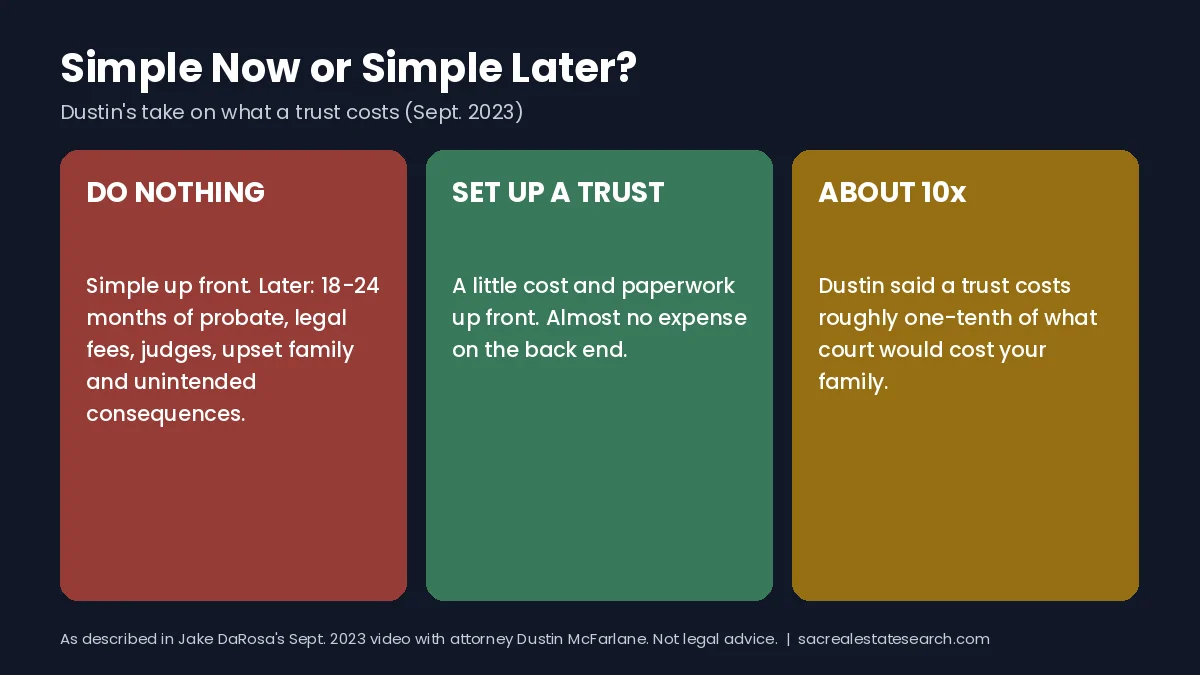
Short answer: Dustin said it's about a 10x difference: you spend roughly one-tenth with a trust of what court would cost your family.
A lot of people come in asking for a "simple trust." Dustin's take is that you can't have it both ways. You either take on a little complexity up front, or a whole lot of complexity on the back end.
- "Simple" now: Do nothing. But on the back end, Dustin described 18 months to two years of probate court, legal fees, judges, lawyers, upset family members and unintended consequences.
- Simple later: A little cost and some paperwork now (my binder was a couple hundred pages), and almost no expense on the back end.
He even mentioned conservatorships for people with almost nothing to their name that still ran up around a $20,000 bill with the court system. His view: a trust is the simplest, easiest and cheapest way to take care of yourself and your family.
I'll be honest: I wasn't in the "I'll be dead anyway" camp. For me it was time. I didn't want the hassle. But it really wasn't a big time investment, and the team did most of the work.
What are the steps to set up a living trust?
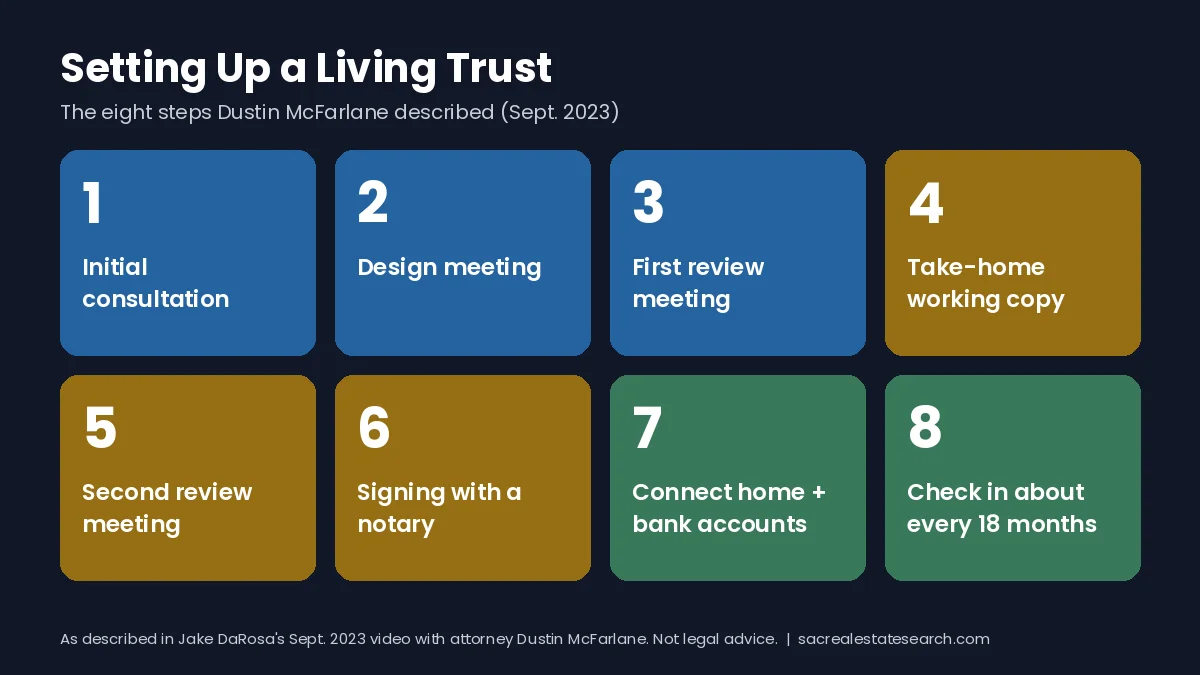
Short answer: Dustin described an eight-step process, from a first meeting through funding the trust and regular check-ins.
Here's how he walked through it:
1. Initial consultation. You meet each other and make sure it's a good fit and that it's a problem they can solve.
2. Design meeting. You decide who's in charge of financial, real estate and health care decisions, and who inherits what.
3. First review meeting. They go over the draft documents with you.
4. Take-home working copy. You get a binder to read, mark up and bring questions back.
5. Second review meeting. They answer your questions and make changes.
6. Signing meeting. One last review, and everything is signed with a notary.
7. Connect your assets. Dustin called this the most important part: connecting your real estate and your bank accounts to the trust. When I did mine, someone from the office went to the bank with me to get my accounts set up.
8. Keep it current. He said they check in about every 18 months to ask about marriages, divorces, deaths, new kids and other life changes, so the documents don't go stale.
That last point matters. The worst time to find out your documents are outdated is when you get sick or pass away.
Can an estate planning attorney help after someone has passed away?
Short answer: Yes. Dustin said they also help executors and successor trustees with estate administration.
He explained that estate planning (wills, trusts, powers of attorney and health care directives) is for people planning for themselves. If someone has already passed away and you're the executor or the successor trustee, there's an administration process. Without a trust, that's a probate administration in court. With a trust, it's a trust administration outside of court, but there's still a process to follow the trust's terms and transfer assets to the beneficiaries. He also mentioned his office doesn't handle litigation or contested matters.
FAQ: Living trusts and estate planning
What is a living trust?
In this conversation, Dustin described a trust and estate plan as a written plan that names who's in charge of your money, property and health care if you get sick, and who's in charge and who inherits when you die, without going through court.
What happens if I die without a will in California?
Dustin said California's intestate succession rules decide who inherits, and a probate judge has to oversee the distribution. He said that usually means hiring a lawyer and a year to a year and a half.
Should I add my kids or grandkids to my house deed?
Not without legal advice. In one story from the video, adding a two-year-old granddaughter to title meant the homeowner later needed a court guardianship and a blocked account for the granddaughter's half to sell.
How much does a living trust cost compared to probate?
Dustin said it's about a 10x difference: setting up a trust costs roughly one-tenth of what court would cost your family. Costs vary, so ask an attorney for a quote.
Do I need to do anything after signing my trust?
Yes. Dustin said the most important step is connecting your real estate and bank accounts to the trust, then reviewing the plan as your life changes.
Does a trust help if I'm selling a home?
If the owner has passed away or can't make decisions, having a trust and the right documents in place can avoid a court process before the home can be sold or transferred. If you're dealing with an inherited home in Greater Sacramento, reach out to me and I'll walk you through the real estate side.
Selling or buying a home in Greater Sacramento?
Whether you're inheriting a home, downsizing or buying your next place, I'll help you with the real estate side and make sure you're asking the right questions before you move, in Sacramento, Placer or El Dorado County.
- 📅 Book a 1-on-1 strategy call
- 📞 Call or text Jake: (916) 402-5786
- 🡠Search Greater Sacramento homes for sale
- 📘 Grab the free Greater Sacramento Relocation Guide (Sacramento, Placer and El Dorado counties).
Related reading:
- Sacramento home insurance: what buyers need to know
- Sacramento home inspections: why waiving them can backfire
- Sacramento's 2023 low-inventory market: what a local appraiser saw
- Home buying 101: earnest money deposit vs. down payment
- 5 benefits of home ownership vs. renting
Jake DaRosa | The DaRosa Team | Keller Williams Roseville, powered by PLACE
📧 jake@sacrealestatesearch.com · 📞 (916) 402-5786 · 🌠sacrealestatesearch.com
DRE #01704082 | Brokerage DRE #01406150
This article is general information based on a video filmed in September 2023. It is not legal, tax or financial advice, and it does not create an attorney-client relationship. Estate planning laws, timelines and costs change and depend on your situation; consult a licensed California estate planning attorney. Information is deemed reliable but not guaranteed. Equal Housing Opportunity.
or another way