

Categories
RelocationPublished November 20, 2026
6 Reasons You Might Not Survive Living in Greater Sacramento (Watch Before Moving)

A lot of people move to the Greater Sacramento area excited for a fresh start, and then run into a few things that make them second-guess the decision. I've heard it all, from "I wish I'd known this before moving" to "I can't believe they're actually doing this here." I've lived in this area for over 48 years and I've been a broker for 22 of them (as of January 2025), so in this January 2025 video I walked through the six things that cause some people not to last here. Below is the full video plus a rundown of each one.
Video by Jake DaRosa, The DaRosa Team | Keller Williams Roseville, powered by PLACE (published January 2025). Watch on YouTube.
Prefer watching? Subscribe on YouTube for Greater Sacramento market updates, neighborhood tours and honest takes on living here.
Heads up: Everything below is what I said in my January 2025 video. Numbers like heat days, utility bills, Mello-Roos amounts and commute times are my observations as of early 2025, not official data. They change over time and vary a lot by neighborhood and home, so check the details for any home you're considering.
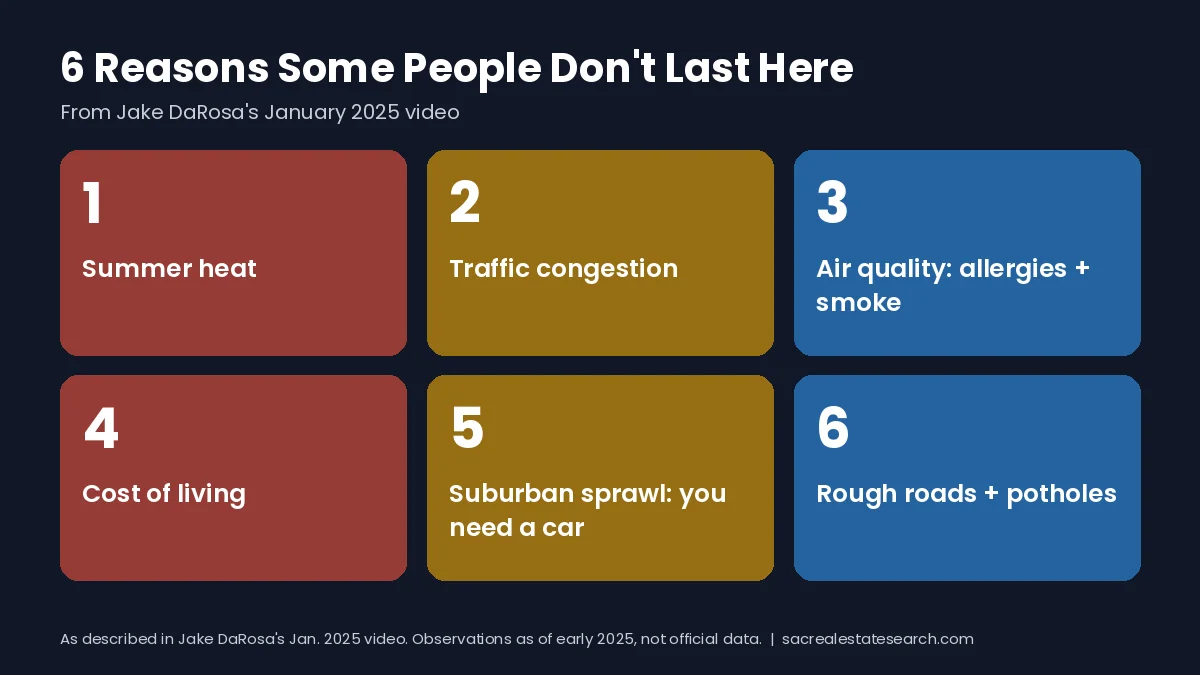
Key Takeaways
- Summers get hot. On average the Sacramento area sees about 23 days over 100°, and I said 2024 had 45. Winters are mild, mostly in the 40s to 60s.
- Traffic is real. I-80 in Roseville near Highway 65, Highway 50 in and out of downtown, and Highway 99 toward Elk Grove can get really busy. Roseville to downtown can be 30 minutes to an hour each way.
- Air quality can be rough. We're the City of Trees, so allergy season hits hard, and wildfire smoke has kept people indoors in recent years.
- Cost of living adds up in layers. Rising energy bills, Mello-Roos in many newer communities and some of the highest gas prices in the country, as of early 2025.
- Plan on owning a car. Downtown is walkable, but most of the area is suburban and transit is nothing like BART.
- The bonus one: roads. Potholes are a big topic in local social media groups, and they mean more wear on your car.
Is Sacramento too hot to live in?
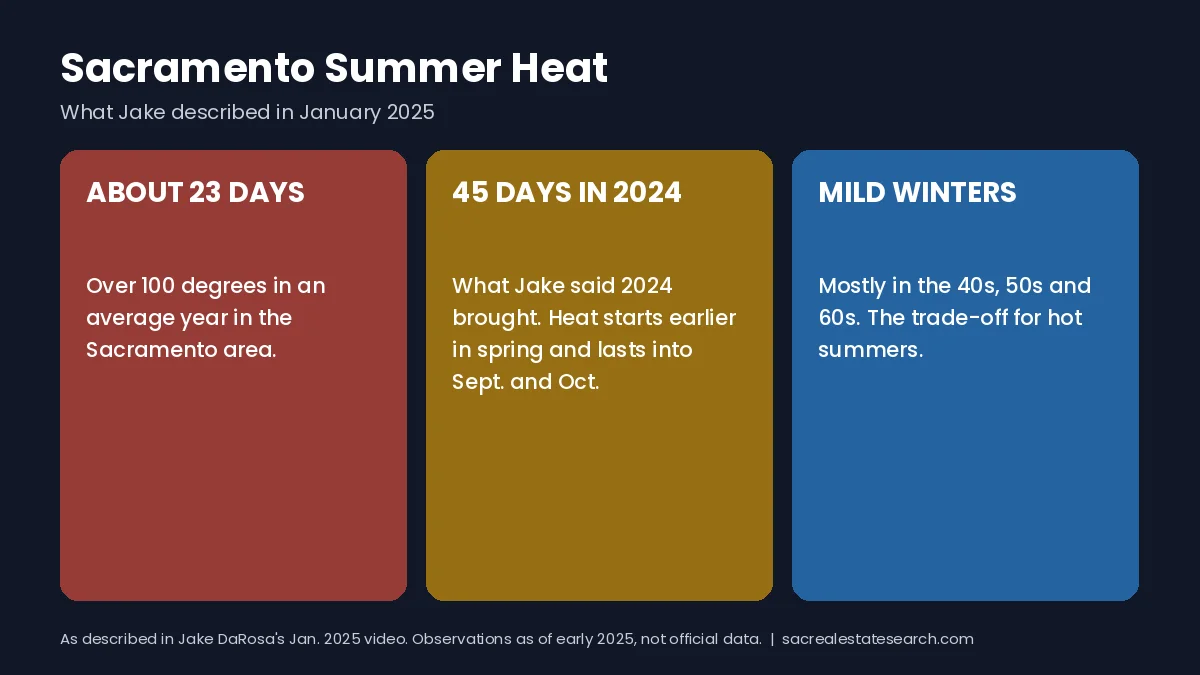
Short answer: Summers here test people. Winters are the trade-off.
The first thing to know about moving to Greater Sacramento is the weather. We get pretty hot in the summertime. To give you some perspective, the Sacramento area usually has about 23 days over 100° in an average year. In 2024, I said we actually had 45.
Over the last couple of years I've felt the heat intensify. Our seasons seem to be shortening, with earlier heat cutting into spring and fall staying hot longer. Hot weather in September and October isn't uncommon anymore. It's a pattern I keep seeing.
The flip side is that our winters are very mild. You're sitting in the 40s, 50s and 60s. For me, 50 feels cold, but if you're coming from somewhere like Colorado or Idaho, you'll probably love our winters. So it's a trade-off. Like the old saying goes, if you can't take the heat, stay out of the kitchen (or the Sacramento area).
How bad is traffic in Greater Sacramento?
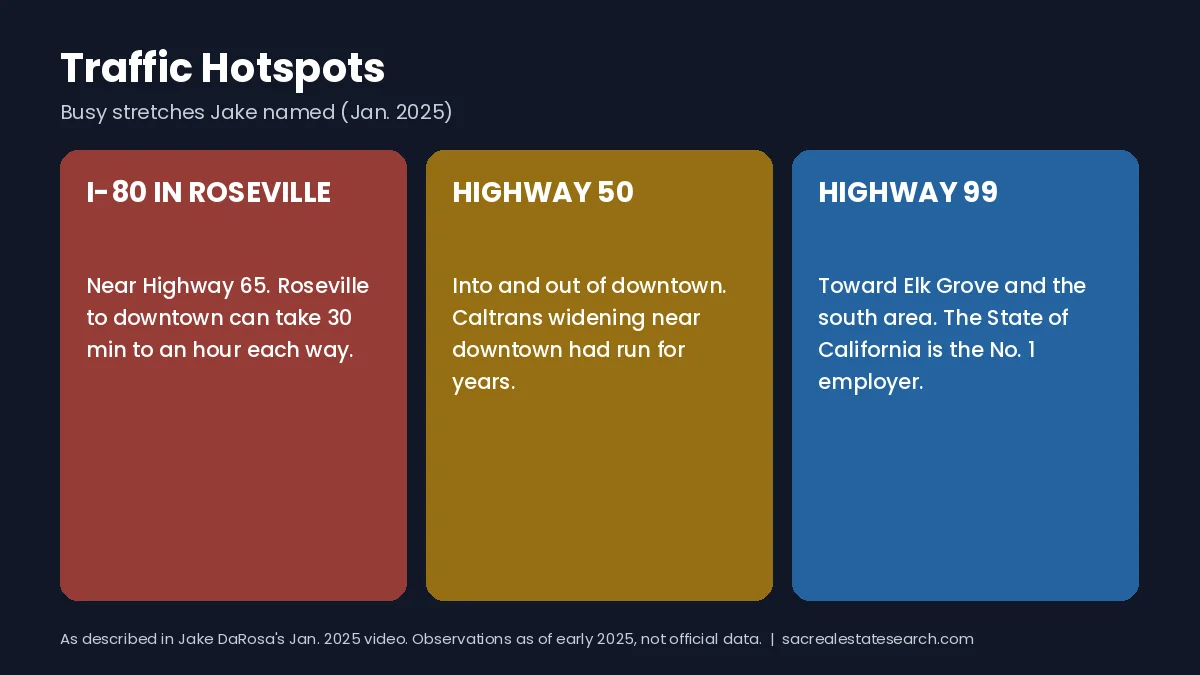
Short answer: Depending on where you live and work, it can be a real daily challenge.
Depending on where you call home, a few stretches get really busy:
- I-80 in Roseville, close to Highway 65
- Highway 50 going into and coming out of downtown
- Highway 99 heading into Elk Grove and the south area
One of the big reasons is that we're the state capital, with a lot of government jobs. In fact, our number one employer is the State of California. A lot of people commute into work downtown and back out to suburbs like Folsom, Roseville and Rocklin, and that builds congestion on the freeways.
Caltrans is working on widening some freeways, but those projects take a long time. As of early 2025, the work on Highway 50 near downtown Sacramento had been going on for several years. Combine that with the everyday traffic and it can be a mess. If you're commuting from Roseville into downtown Sacramento, plan on anywhere from 30 or 45 minutes to an hour each way, depending on where you work.
How bad is the air quality in Sacramento?
Short answer: Allergy season and wildfire smoke are the two big ones.
Sacramento is known as the City of Trees, and as I said in the video, we're known for having a lot of trees per square foot. That means when allergy season runs through the area, people with allergies can be absolutely miserable. Knock on wood, I've never had allergies even though I've lived here my whole life, but I have friends who struggle every year. Between all the trees and grasses, there's a lot of pollen in the air.
The other piece is fire season. Over the last couple of years we've had some large fires in the region that made the air smoky. There have been times when people were told not to go outside or do outdoor activities because the smoke could be harmful. If you're up in El Dorado County, or around Auburn and Placer County, and there's a fire nearby, you're not going to be happy.
If you have allergies or breathing concerns, factor this into where and when you look.
Is the cost of living high in Greater Sacramento?
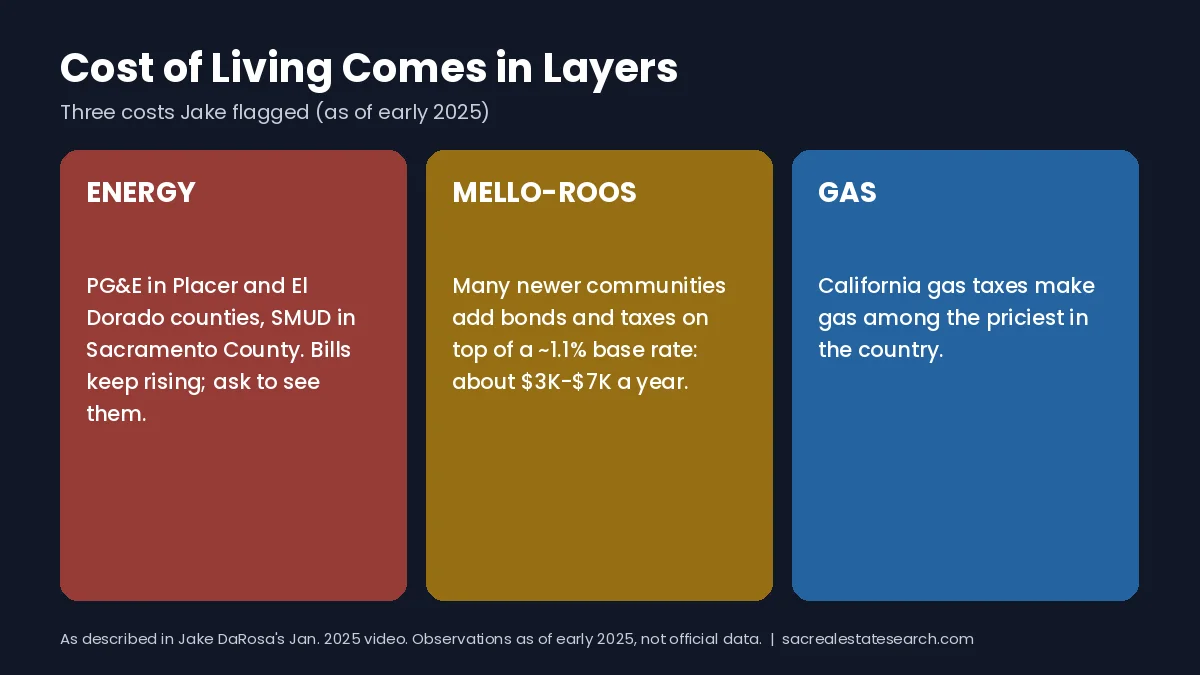
Short answer: It can be, and it comes in layers: energy, Mello-Roos and gas.
Energy bills. Your utility depends on where you live. In Placer or El Dorado County, your electricity is likely through PG&E. With the lawsuits and fire issues, their rates keep rising. I know people without solar who are paying $400, $500, $600, $700 a month or more to run their house. If you're moving here, ask to see the energy bills on any home you're considering, and if a home has solar, that can be a plus.
I'm in Sacramento County, in the Fair Oaks area, so I'm on SMUD. Their rates aren't terrible, but I've seen them going up too. Either way, expect energy to be a real line item in your budget.
Mello-Roos. In a lot of newer housing communities you'll see what we call Mello-Roos. These are bonds and taxes added to your property tax bill to pay for building out that community. So your base property tax rate might be around 1.1%, and then on top of that you could have an extra $3,000 to $7,000 a year, as I described it in early 2025. Ask about this before you write an offer on new construction.
Gas. If you're moving from out of state, California has a lot of gas taxes, which makes us one of the highest-priced states for gas.
Put those together and the cost of living here can be challenging.
Do you need a car to live in Greater Sacramento?
Short answer: In most of the area, yes.
The fifth thing is what I call the suburban sprawl. Some spots are very walkable. Downtown Sacramento is awesome. You can walk to a Kings game, walk to restaurants and more.
But a lot of the new homes, and a lot of where people are buying, is suburban. Most activities mean getting in the car. Our public transportation isn't on the level of San Francisco's BART, which can take you all over. We have buses and some rail, but nothing like that.
So plan on owning a car. Depending on where you buy, getting to a game, a kid's soccer match or other entertainment will mean driving there.
Why do people complain about the roads in Sacramento?
Short answer: Potholes, and the feeling that tax dollars aren't going into road repair.
The sixth and final thing is one you may not see in the news, but it runs deep in local social media groups and chats: our roads. From the highways to the surface streets, a lot of them are rough.
We pay a lot in taxes, and a lot of people want to know where that money is going, whether it's city or county dollars, because it doesn't seem to be going into the roads. There are tons of potholes, and that leads to extra maintenance on your car. It's a big issue a lot of residents are talking about.
So should you still move to Greater Sacramento?
Short answer: If you go in prepared, there's plenty to love here.
None of these are deal-breakers for most people. They're just things to plan for. If you're ready for the heat, think carefully about your commute, budget for energy, Mello-Roos and gas, and expect to drive, you'll be in a much better spot than people who move here without knowing.
That's why our team put together a free Greater Sacramento Relocation Guide. It's meant to save you hours of research, covering top employers, hospitals, schools and much more you'll want to know before the move.
Where are you moving from? Drop it in the comments on the video. I'd love to know who's watching.
FAQ: Living in Greater Sacramento
How hot does Sacramento get in the summer?
In my January 2025 video I said the Sacramento area usually averages about 23 days over 100° a year, and 2024 had 45. Heat has also been showing up earlier in spring and lasting into September and October.
What are the worst commutes in Greater Sacramento?
The ones I called out were I-80 in Roseville near Highway 65, Highway 50 in and out of downtown, and Highway 99 toward Elk Grove. As of early 2025, Roseville to downtown Sacramento could take 30 minutes to an hour each way.
What is Mello-Roos?
Mello-Roos is a set of bonds and taxes added to the property tax bill in many newer communities to help pay for that community's development. In the video I described it as an extra $3,000 to $7,000 a year on top of a base rate around 1.1%. Amounts vary by community, so check the tax bill for any specific home.
Who provides electricity in the Sacramento area?
As I explained it, homes in Placer and El Dorado counties are generally on PG&E, and in Sacramento County (like my area in Fair Oaks) you may be on SMUD. Ask to see recent energy bills before you buy.
Do I need a car in Sacramento?
For most of the region, yes. Downtown Sacramento is walkable, but the suburbs are spread out and transit is mostly buses and some rail.
Is moving to Greater Sacramento still worth it?
For a lot of people, yes. Mild winters and plenty of things to love come with these trade-offs. Knowing them up front helps you pick the right area and the right home.
Thinking about moving to Greater Sacramento?
I love making these videos, but what I love even more is helping families from across the country make the move here. Whether you're coming next week, next month or next year, I'll help you sort out commutes, energy costs, Mello-Roos and the right neighborhood in Sacramento, Placer or El Dorado County.
- 📅 Book a 1-on-1 strategy call
- 📞 Call or text Jake: (916) 402-5786
- 🏡 Search Greater Sacramento homes for sale
- 📘 Grab the free Greater Sacramento Relocation Guide (Sacramento, Placer and El Dorado counties).
Related reading:
- Don't move to Greater Sacramento in 2026 until you know these 6 things
- Why people are leaving Sacramento: the real reasons
- 10 things I love about living in Greater Sacramento
- Your guide to buying a new construction home in Greater Sacramento
- Sacramento home insurance: what buyers need to know
Jake DaRosa | The DaRosa Team | Keller Williams Roseville, powered by PLACE
📧 jake@sacrealestatesearch.com · 📞 (916) 402-5786 · 🌐 sacrealestatesearch.com
DRE #01704082 | Brokerage DRE #01406150
This article is general information based on a video filmed in January 2025. Weather, traffic, utility rates, taxes, Mello-Roos and other costs change over time and vary by location and property; verify details for any home you're considering. It is not tax or financial advice. Information is deemed reliable but not guaranteed. Equal Housing Opportunity.
or another way